In this video, I explore how the 4-Year U framework—originally designed to help people set and achieve meaningful goals—can also help us understand the natural rhythm of relationships. Whether it’s dating, building a partnership, or growing in marriage, relationships follow the same cyclical structure that governs our creative and personal growth: Winter, Spring, Summer, and Fall.
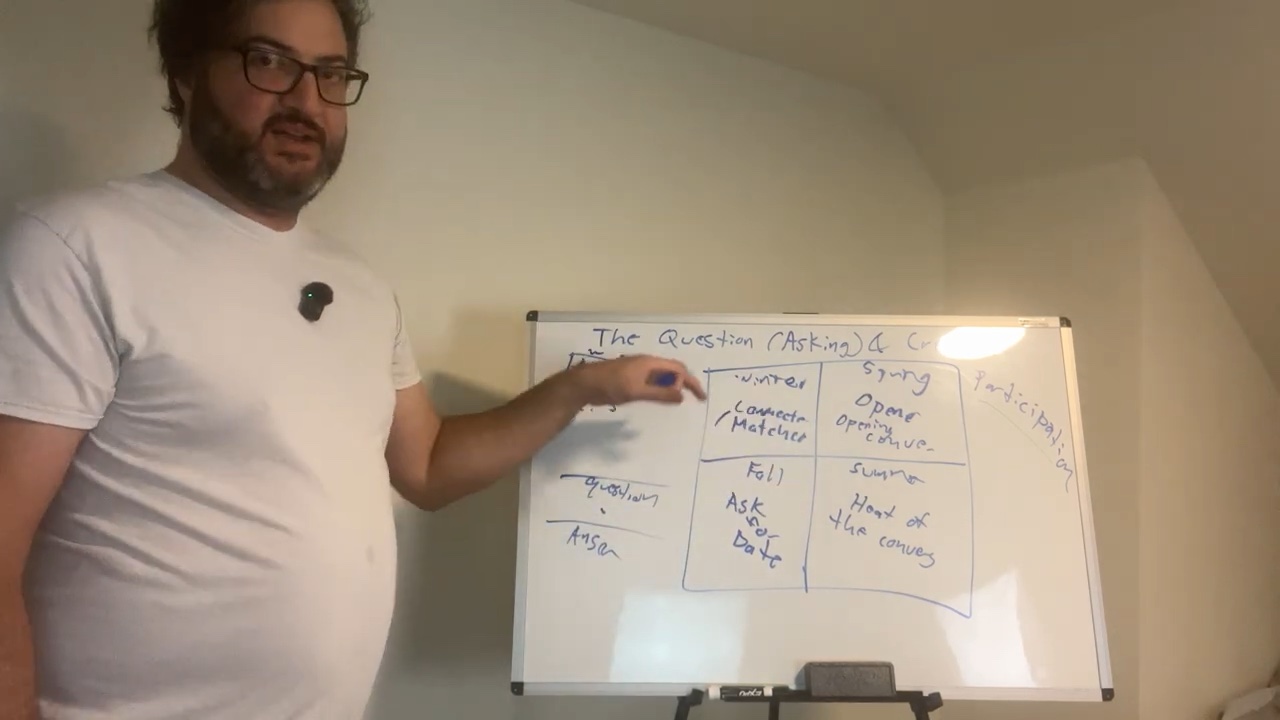
The Seasonal Quadrant: From Question to Participation
At its core, the 4-Year U system maps life’s cycles as a series of seasons, each representing a stage of movement between a question and an answer. These stages aren’t just linear—they’re cyclical and fractal, repeating at both micro and macro levels. Every relationship, from the first connection to lifelong partnership, moves through these same energetic patterns of asking, responding, and co-creating.
Winter – Connection or Matching This is where everything begins. It’s the moment of mutual potential—like when two people match on a dating app. Nothing’s happening yet, but a spark has been lit. Winter represents the question—“Do we want to connect?”—and it’s the season of preparation and readiness.
Spring – Opening Conversation In spring, someone takes initiative and starts the conversation. One person leads by asking a question; the other responds. This is where creative participation begins. Just like new growth after winter, spring requires attention, warmth, and responsiveness.
Summer – Heat of the Conversation Summer is the height of energy and activity—the heat of connection. The conversation deepens, emotions warm, and the relationship takes shape. This is where chemistry grows and shared experiences form the foundation for what comes next.
Fall – Asking for the Date Fall represents decisions and transitions. After building momentum, someone asks: “Do we want to move forward?” This could be asking for a date, defining the relationship, or choosing to commit at a deeper level. Fall closes one cycle—and prepares the next.
Micro and Macro Cycles
Each stage of a relationship contains smaller versions of the same cycle. The macro journey—dating app, first date, relationship, marriage—contains micro-cycles within it.
For example:
The app phase goes from matching to chatting to meeting in person.
The first date goes from greeting (winter), to small talk (spring), to deep conversation (summer), to next steps (fall).
Even within marriage, you repeat these rhythms every day: coming home (winter), reconnecting (spring), engaging deeply (summer), and acting together (fall).
The key insight is that relationships grow through creative participation. One person leads, the other follows, and then the roles reverse. When one person jumps ahead—trying to rush through the natural progression—the structure breaks down. By honoring the sequence, you stay aligned with the natural flow of connection.
Why This Matters
Just as 4-Year U helps you move from dreaming to doing in your goals, it also helps you see that relationships flourish when they follow their natural timing. Skipping seasons, forcing growth, or resisting change creates imbalance. But when you participate fully in each stage—asking, listening, responding, creating—you move in rhythm with life itself.
Every transformation starts with a shift in identity. Before you can “have” the results you want, you must “be” the kind of person who naturally creates them. Most people try to change their circumstances first—but true change flows from who you believe yourself to be.
As discussed in the video, you don’t need to become someone new from scratch. You already are the person you’re meant to be—you’re simply catching up to that version of yourself. The smallest evidence of that identity can start the process. If you earn even a few cents in interest from a savings account, then technically, you already make money in your sleep. That simple truth is evidence of the identity you’re growing into.
The Structure of Transformation: Be → Do → Have
Lasting change follows a simple but powerful sequence:
Be – Adopt a new identity or belief about who you are.
Do – Act in alignment with that belief, making choices that reflect it.
Have – Receive the results that naturally follow from your actions.
There’s no such thing as an overnight success. What looks like a sudden transformation is the compound effect of hundreds of small, consistent choices. Each micro decision reinforces your identity—either the old one that keeps you stuck, or the new one that moves you forward.
Every time you choose discipline over comfort, learning over distraction, or courage over fear, you strengthen the belief that you are the kind of person who succeeds. Those choices accumulate. Eventually, they produce the macro results everyone can see.
The Fear of Outgrowing the Bucket
When you start to change, others may resist your growth. Like crabs in a bucket pulling one another down, people sometimes prefer you to stay within familiar boundaries. Recognize this as a natural part of transformation, not a sign to stop. Every new level requires acclimation—a period of adjustment as your internal reality catches up to your external goals.
Just like climbers ascending Everest pause at base camps to acclimate, you’ll need moments to catch your breath as you grow. The key is not to retreat to comfort, but to keep acclimating forward.
Your Future Self Already Exists
Your future self isn’t imaginary—it’s a real version of you waiting for you to align with her. She already believes, already acts, already enjoys the life you’re moving toward. She’s looking back, cheering you on, saying, “I’m just waiting on you to catch up.”
Spend time visualizing her. What does she do each morning? What choices has she already made that you can make today? This simple practice rewires your brain’s reticular activating system (RAS)—the internal filter that determines what you notice and pursue.
What You Focus On Expands
Your RAS constantly scans the world for information that supports your dominant thoughts. If you focus on lack, you’ll see only limitation. If you focus on abundance, you’ll start spotting opportunity everywhere. Identity and attention are linked—who you are is what you look for.
So start looking for evidence that supports the person you’re becoming. Every small confirmation builds momentum toward transformation.
The 4-Year U. Connection
At 4-Year U., we believe identity transformation is the foundation of sustainable growth. Whether you’re setting financial goals, building creative projects, or pursuing spiritual maturity, everything begins with how you see yourself.
Your 4-Year U. journey isn’t about forcing change—it’s about remembering who you’re meant to be and taking small, aligned steps toward that identity every day.
We all know what it’s like to get stuck putting out fires—doing what’s urgent but not what’s truly important. For many people, especially those under constant stress or financial strain, this short-term cycle becomes the default. Psychologists call it a cognitive tax—the mental load that makes it nearly impossible to think long-term when survival is all-consuming.
But what if there was a simple structure to help anyone start thinking long-term again? That’s exactly what the 4-Year U. system is designed to do.
(Watch the video below to see this explained visually.)
From the Urgent to the Important
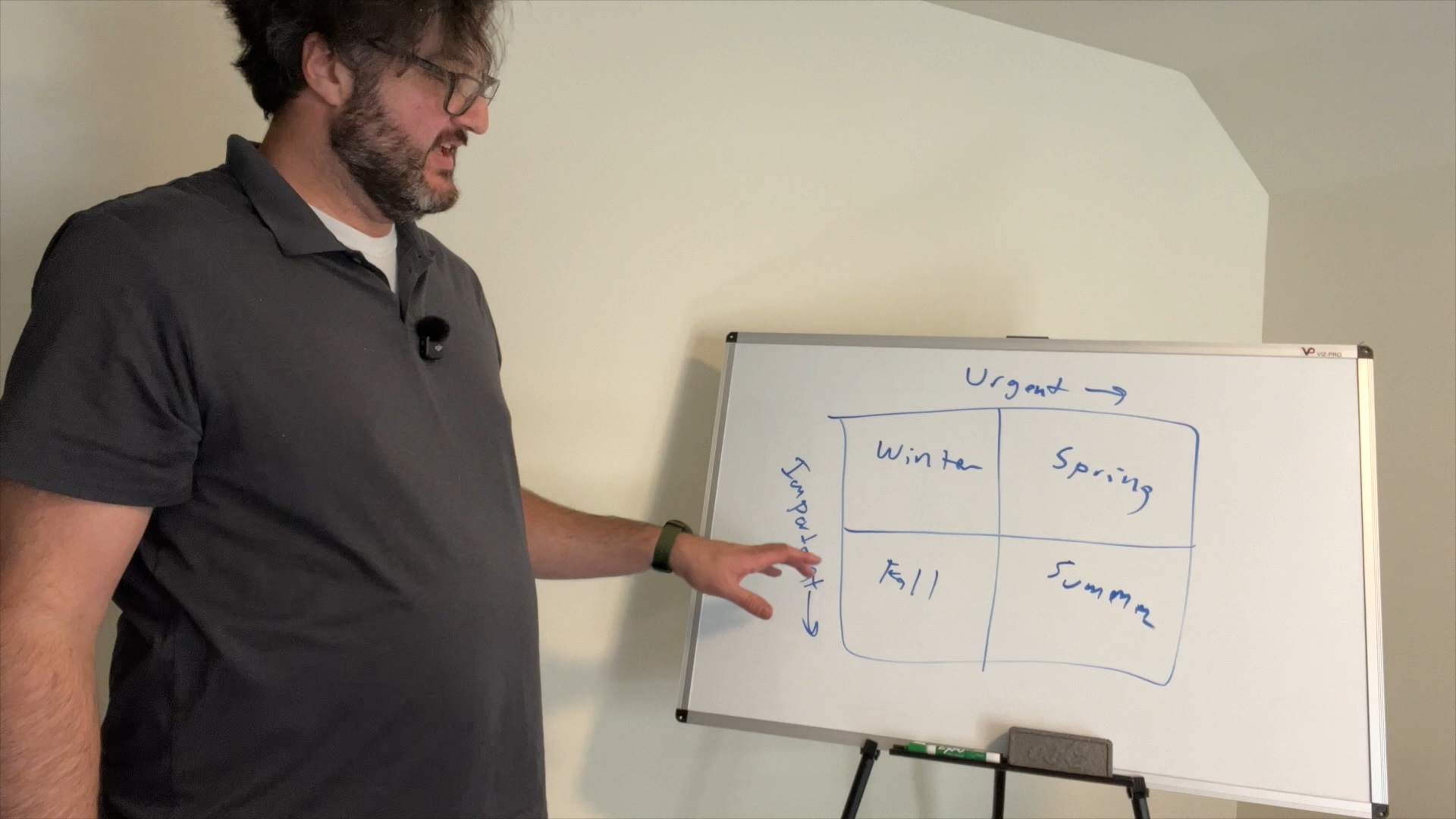
Let’s start with a simple model: the Eisenhower Matrix. You’ve probably seen it—urgent vs. important. Most people spend their lives doing things that are urgent but not important. They’re reacting instead of creating.
In the short term, that can feel productive. But in the long term, it keeps you stuck.
The goal is to spend more time in the important but not urgent zone—where you’re building, preparing, and planting seeds for your future. That’s how you grow out of the cycle of reactivity and into one of intentional living.
The Seasons of Life
Here’s where we introduce a different way to think about this matrix: the seasons.
Summer – Urgent and important. The work season.
Fall – Important but not urgent. The harvest season.
Winter – Not urgent, not important. The season of rest.
Spring – Preparation. The season of planting and setup.
When you see your activities through these seasons, it becomes easier to balance your life. You can’t stay in summer forever, and you can’t remain in winter too long either. You need all four.
Thinking in Four-Year Cycles
Now, let’s zoom out.
Remember how your life had structure growing up? Grade school, middle school, high school, maybe college—each roughly four years. Each one had a built-in plan. But after that, most people stop building structured programs for themselves.
What if you brought that structure back?
The idea is to think in four-year blocks. In year one, you’re in winter—resting and dreaming. Year two is spring—preparing and planning. Year three is summer—doing the work. Year four is fall—reaping the harvest.
Then you repeat. Each four-year cycle builds on the last.
The Power of Structure
Most people don’t fail because they’re lazy. They fail because they lack structure.
Think about it like this: every question in life has both a question and an answer. But it also has a place to put the question and a place to put the answer. Without that, everything feels chaotic and undefined.
When you were in school, the structure was given to you—assignments, deadlines, grades. But in adulthood, you have to build your own structure. The 4-Year U. framework gives you that.
It creates a place for the questions—your goals—and a space for the answers—your actions.
Working with Natural Cycles
You can apply this four-season rhythm at any scale:
Daily: Morning (spring), midday (summer), evening (fall), night (winter).
Monthly: Early month (spring), mid-month (summer), end of month (fall), reset (winter).
Yearly: Spring (prep), summer (action), fall (harvest), winter (rest).
Every four years: A full life cycle of growth, maturity, and renewal.
This pattern is built into creation itself. You’re not fighting time—you’re flowing with it.
Begin with the End in Mind
Let’s say your goal is to own a home in four years, but right now you’re homeless. You start by asking the right question: How can I get a home in four years? That’s your fixed point. Then you work backward.
What could you do in year one, two, and three to make it happen? Even if you fall short, you’ll end up far closer than if you never started.
The truth is, most goals don’t take as long as we think. We just procrastinate because we assume they will. The 4-Year U. method breaks that paralysis by giving you structure, momentum, and hope.
A Life Built in Seasons
When you see your life as a series of structured seasons—each with its own rhythm—you begin to think long-term again. You start to escape short-term survival mode and build something lasting.
The 4-Year U. system isn’t just a planner. It’s a way of aligning your life with natural cycles of growth, work, rest, and reward—so that over time, your life compounds in meaning, purpose, and results.
In a world full of self-improvement systems and productivity methods, few frameworks connect the inner, structural, and practical dimensions of life as seamlessly as 4-Year U. Rooted in the rhythms of nature and human transformation, 4-Year U serves as a unifying architecture that integrates the work of Robert Fritz, Joe Dispenza, and David Allen (author of Getting Things Done)—weaving together identity, structure, action, and time into one living system.
The Core of 4-Year U: Time and Rhythm 4-Year U operates on a cyclical foundation inspired by the natural seasons. Each four-year arc is divided into seasonal quadrants that reflect the phases of creation and renewal:
Winter – Vision & Rest: Reflect, dream, and define the future you want to create.
Spring – Prepare: Build systems, develop plans, and cultivate the habits that support your goals.
Summer – Do: Take consistent action and live out your vision in real time.
Fall – Reflect & Harvest: Review, integrate, and celebrate your growth.
This rhythm ensures that transformation doesn’t burn out but flows in sustainable cycles of effort, rest, and renewal. It’s the tempo that allows everything else—identity, structure, and action—to align.
Robert Fritz: The Structure Behind Behavior Robert Fritz teaches that structure determines behavior. The outcomes in your life flow naturally from the structure you’re in. If the underlying system is one of conflict or oscillation (wanting change but believing it’s impossible), your results will mirror that. But if the structure is one of creative tension—where your vision and current reality exist in a healthy, balanced relationship—then forward motion becomes inevitable.
4-Year U builds this concept directly into its design. Each season functions as a resolution of structural tension:
You clarify a vision (future state).
You face current reality with honesty.
You act in ways that resolve the tension between the two.
By reestablishing this creative structure every season, you stay in an advancing structure—the kind that leads to genuine, repeatable progress.
Joe Dispenza: The Identity of the Creator Joe Dispenza’s work focuses on transforming the self from the inside out. He teaches that your identity—the way you think, feel, and act—is largely a product of past conditioning. True change requires creating a new identity and emotionally living as that future self before it appears.
In 4-Year U, this principle plays out across the seasons:
Winter: You imagine your ideal self—the person who embodies your future vision.
Spring: You start reprogramming daily habits to align with that identity.
Summer: You act from that identity in every decision and behavior.
Fall: You reflect on how that identity has evolved and solidified.
As the cycle repeats, identity shifts naturally through the rhythm of vision, preparation, action, and reflection. The system ensures that you’re not forcing transformation—you’re living it.
David Allen: The Context for Action David Allen’s Getting Things Done (GTD) method provides the bridge between vision and execution. Allen emphasizes context—the environment or toolset in which an action can be completed. GTD brings order to your commitments through a structured flow: Capture → Clarify → Organize → Reflect → Engage.
In 4-Year U, this concept scales upward. Each season serves as a macro-context that determines which types of actions matter most:
Winter = strategic and reflective actions.
Spring = organizational and preparatory actions.
Summer = productive and outward actions.
Fall = evaluative and integrative actions.
By syncing daily actions to seasonal context, you stay aligned with both your structure and your identity—avoiding burnout and maintaining momentum.
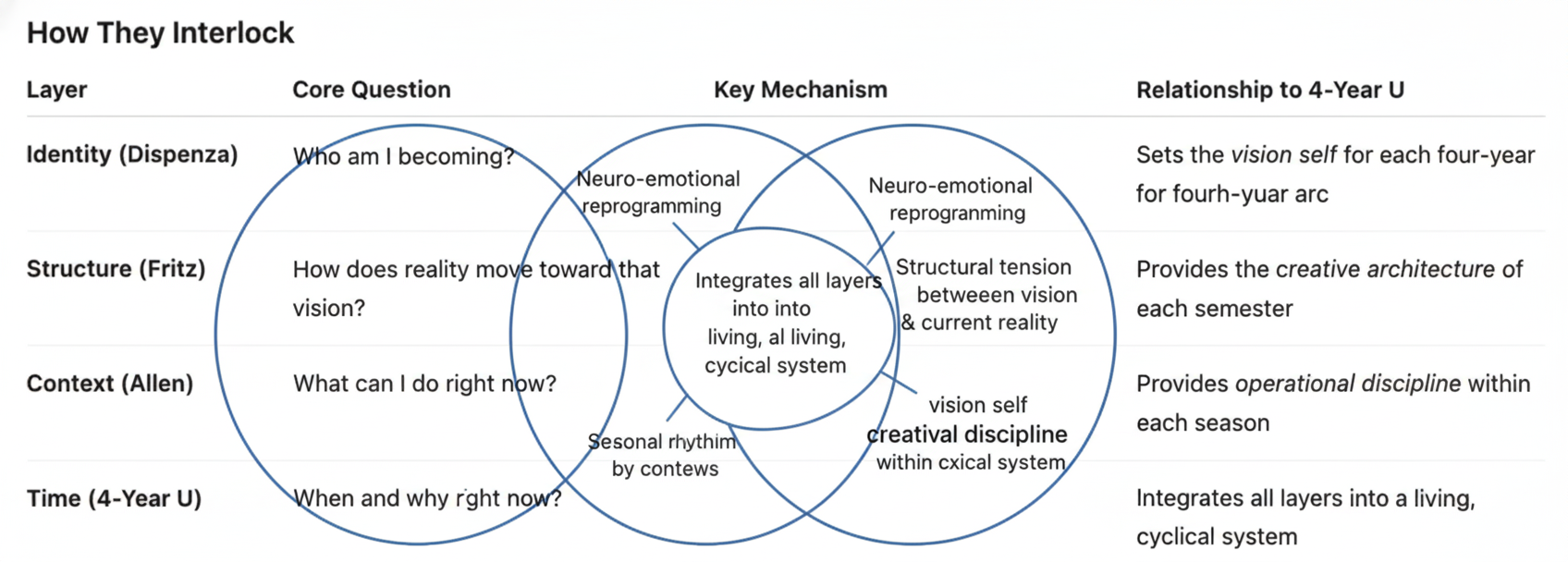
The Unified System: Being, Structure, Doing, and Time
Here’s how all four frameworks work together inside 4-Year U:
Identity (Dispenza)
Core Question: Who am I becoming?
Key Mechanism: Neuro-emotional reprogramming
Relationship to 4-Year U: Sets the vision self for each four-year arc
Structure (Fritz)
Core Question: How does reality move toward that vision?
Key Mechanism: Structural tension between vision and current reality
Relationship to 4-Year U: Provides the creative architecture of each semester
Context (Allen)
Core Question: What can I do right now?
Key Mechanism: Action management by context
Relationship to 4-Year U: Provides operational discipline within each season
Time (4-Year U)
Core Question: When and why do I do this?
Key Mechanism: Seasonal rhythm and reviews
Relationship to 4-Year U: Integrates all layers into a living, cyclical system
The Full Picture
Dispenza – inner being shift (identity)
Fritz – structural alignment (form)
Allen – contextual execution (function)
4-Year U – cyclical timing (flow)
Together, these frameworks form a complete system for creation and transformation: Being (Dispenza) organized by Structure (Fritz), expressed through Action (Allen), and sustained through Rhythm (4-Year U).
This is the essence of 4-Year U—a structure for not just setting goals, but becoming someone who naturally lives them out. It’s not a to-do list; it’s a life architecture.
How Thinking Long-Term Helped Me Accomplish Bigger Goals in Less Time
When I created Four Year U., it wasn’t because I had all the answers. It was because I noticed a pattern in my life: everything seemed to move in four-year cycles. Jobs, relationships, major shifts—they all tended to evolve or change every four years. So I asked myself, What if I stopped leaving that to chance? What if I started living intentionally in four-year arcs?
Like most people, I used to think in terms of yearly resolutions. Every January, I’d set a new goal. Twelve months later, I’d either celebrate success or quietly reset with a new goal, never quite building on the momentum of the previous year.
Year-long thinking started to feel limiting. The goals felt smaller because the timeline was short. I wanted to think bigger.
And when I did, something unexpected happened: I started achieving more in less time.
Bigger Goals. Faster Results.
The moment I started thinking in four-year arcs, my mindset changed. I gave myself permission to dream bigger—to set ambitious, meaningful goals that wouldn’t fit in a single year. But here’s the surprise:
Goals I thought would take a year? I completed them in just three months.
Projects I assumed needed 90 days? Done in four weeks.
Why? Because once I had a clear long-term vision and structure, I could stop spinning my wheels. I could just… start.
The Real Cause of Procrastination
Procrastination often comes from ambiguity, not laziness. When we don’t have a clear structure for our goals—when we don’t even know where to write the answer to the question we’re asking ourselves—we stall.
Think of it like a worksheet in school. The teacher gives you a question and a spot to answer it. But in adult life, when you’re setting your own goals, you have to create both the question and the answer space.
That added layer of effort can cause hesitation. We avoid it because it feels overwhelming. But once I built a repeatable system—the 4-Year U. framework—I no longer had to figure out the structure. It was already there.
Prepare the Workspace. Then Work the Work.
This became a mantra for me.
I started to take what I call a “TikTok approach”—not the app, but the rhythm: prepare, then act.Create the space. Then show up and do the work. Set the stage. Then perform.
The 4-Year U. system is that space. It gives you the structure to dream big, break it down, and build toward it—quarter by quarter, month by month, week by week.
And when the structure is in place, you move faster, more confidently, and with less resistance.
The Takeaway
If you feel stuck, maybe the problem isn’t the goal itself. Maybe you just need a better container for it.
Think in four-year arcs. Build the structure. Then prepare the workspace—and work the work.
You’ll be amazed at what you can achieve when you think long-term.
There’s a palpable shift in the air. After more than four years of uncertainty, isolation, and introspection—what felt like a prolonged societal winter catalyzed by the onset of COVID in March 2020—we’re beginning to stir. The days have warmed, the sunshine lingers, and the heaviness of collective anxiety is lifting. Yet as groups once tightly knit begin to drift apart, you might find yourself puzzled by surprising friction: old friendships splintering, conversations growing awkward, and a restless energy bubbling beneath the surface.
This, friends, is the hallmark of spring in the 4-Year U. framework—and here’s why.
From Winter’s Reflection to Spring’s Preparation
In our 4-Year U. model, each four-year arc mimics nature’s seasons:
Winter (Rest & Reflection): A time of inward focus, healing, and conserving energy.
Spring (Preparation & Planting): Seeds of new ideas are planted; foundations are laid.
Summer (Action & Growth): Energy peaks; projects move full-steam ahead.
Fall (Harvest & Release): Achievements are gathered; endings pave the way for the next cycle.
The global “winter” that began in early 2020 forced us into deep reflection—re-evaluating priorities, relationships, and routines. Communities hunkered down; many connections thrived online, even as others atrophied. Now, roughly four years later, that season of introspection is naturally giving way to spring.
Why Relationships Feel Rocky Right Now
Spring is all about preparation—shaking off winter’s inertia to ready ourselves for the coming surge of activity. That process often feels messy:
Unsettled Ground: Old patterns no longer fit. Groups forged in crisis may lose cohesion as circumstances change.
New Priorities: What mattered in winter—safety, stability, digital connection—gives way to renewed desires for travel, in-person gatherings, and fresh pursuits.
Re-planting Social Seeds: As we “plant” new routines and goals, we might outgrow relationships that sustained us during winter, creating natural friction.
Just as farmers clear fields and enrich soil in spring—sometimes disrupting established grass—this season disrupts our social landscapes. It’s less about “failure” and more about transition: making room for new growth.
The Warmth of Spring, Not the Heat of Summer
It’s easy to mistake spring’s energetic optimism for summer’s full-blown momentum. The sun is shining, and the air feels lighter—but in true spring fashion, the world is still budding. We’re laying plans, testing new ideas, and tentatively reaching toward what could be, rather than sprinting headlong into execution (that’s summer’s domain).
Recognizing this distinction helps temper frustration:
Acknowledge the Transition. Notice when old routines or relationships no longer serve your emerging goals.
Plant Thoughtful Seeds. Sketch out new social or creative projects—reach out to reconnect, or explore fresh circles aligned with your springtime aspirations.
Nurture Your Soil. Prioritize self-care, reflection, and small experiments. Read, journal, take walks, and listen to the stirrings of your own next chapter.
Embrace the Discomfort. Growing pains signal transformation. Lean into constructive conversations rather than resisting change.
As we collectively emerge from the winter of the past years, know that this period of social realignment and restless optimism is precisely the spring phase of our next four-year journey. It may feel uneven, even rocky—but out of this fertile ground will come the energy, clarity, and connections ready to burst into the summer of action.
Let the sun warm your face, stay curious about where new paths might lead, and trust that spring’s preparation is the essential prelude to everything you’re poised to achieve.
Life moves in cycles—just like nature. Erich breaks down the seasonal rhythms of life across days, months, years, and even 4-year cycles.
Each season has a purpose. Each one repeats at different levels—daily, monthly, yearly, and over longer arcs of life. Understanding where you are helps you align with time instead of fighting it.
Whether you’re waking up to a new day or facing a new chapter in life, this video will help you recognize your current season and what to focus on next.
Winter
What do you do in the winter season of your life?
So winter is about healing and restoration and just kind of chilling out for a little bit. Sometimes literally chilling because it can be cold. But it doesn’t always just occur in the winter.
Every day has a winter season. Every month has a winter season. Every year has a winter season. Every four years there’s a whole year that’s a winter.
It’s because life is kind of fractal in that way. So the winter season in the day is like when you’re asleep in the morning.
A winter season in the day is like when you’re asleep in the morning. Waking up from your slumber. You’re literally cold. You’re starting to want what you want to do that day.
Winter is when you start to want. Winter is about wanting. Restoration, healing, kind of just recollecting and thinking about what happened and what could happen.
And as we’re at the end of winter, currently in time and we’re about to move into spring and kind of recollect about what happened in winter and start to think about what we want to do in spring, which I’ll talk about in a different video. But for this one, let’s talk about what winter looks like every month.
The first quarter of every month is the winter of the month. That’s typically like the first week. And you’ll notice that’s when people kind of coast a little bit. They run reports to figure out what happened last month. They kind of regroup and do retrospectives and just kind of think about what they want to do that month. And then as you get into the next week, that’s the spring week. That’s when you start planning and working forward on stuff.
So what does it mean at the year level? Well, I think that’s one we’re most familiar with. Everybody’s kind of just like indoors a lot, not really feeling like doing a whole lot, but still kind of imagining what you want your life to be like the rest of the year. Maybe you start to plan your summer vacation in your head, but not like putting pen to paper. You’re just kind of thinking about what you want.
And then there’s every four years where you have a whole year where it’s kind of like that, where it’s kind of a reset.
Spring
What do you do in the spring season of your life?
So spring is about preparing and planting—getting things ready for what’s coming. It’s the time when ideas start to take shape, and actions begin to move from thought to form. You’re not harvesting yet, you’re just getting the soil ready and putting the seeds in.
But just like winter, spring doesn’t only happen once a year. Every day has a spring season. Every month has a spring season. Every year has a spring season. Every four years, there’s even a whole year that’s a spring.
Life’s layered like that. It’s fractal—repeating patterns at different scales.
So the spring season in your day is probably mid-morning. You’re fully awake now. Maybe you’ve had your coffee. You’re not just dreaming anymore—you’re starting to do. You’re organizing your day, writing lists, responding to texts. Setting things in motion.
Spring is about preparation. Momentum. Cleaning up after the thaw. Getting rid of what no longer serves and making space for what might grow.
If we zoom out to the monthly level, spring is usually that second week. You’ve reviewed your numbers and reset your mind in week one—that was winter. Now you’re making plans, creating tasks, scheduling meetings, making purchases. You’re starting to move.
At the yearly level, it’s the actual spring season we all know—March, April, May. People start going outside more. They clean their garages, donate clothes, prep their gardens. Internally, we do that too. We start journaling more, goal-setting, planning vacations, even if we haven’t booked anything yet.
And then there’s the four-year cycle. Every four years, you’ll hit a spring year. That’s a year where the old story has ended, and a new one begins. Maybe you moved, started a new job, launched a new vision. Maybe it’s a year where you’re learning and building again, not fully sure what the harvest will look like, but you’re laying down foundations.
Spring is exciting, but it also takes faith. Because what you plant doesn’t grow overnight. And you have to do the work anyway, believing the harvest will come in time.
Summer
What do you do in the summer season of your life?
Summer is when you do the work. You’re not dreaming anymore. You’re not planning anymore. You’re in the middle of it. This is the season of execution—of showing up, day after day, under the heat of it all.
And just like the other seasons, summer doesn’t only show up once a year. Every day has a summer. Every month has a summer. Every year has a summer. And every four years, there’s a whole year that feels like summer.
Because again—life’s fractal. Patterns repeat at every level.
The summer part of your day? That’s your afternoon. You’re fully engaged now. Deep into projects, meetings, writing, building, delivering, moving. You’re not dreaming about the garden—you’re out there pulling weeds and watering what you planted.
At the monthly level, summer usually falls in the third week. That’s the time when all those plans you made earlier in the month get put into action. The emails get sent, the campaigns launch, the meetings happen, and the momentum builds. You’re too busy to think too far ahead—you’re in it.
At the yearly level, summer is familiar—it’s June, July, August. Things are at their peak. Projects launched in spring are moving fast. People are active, visible, vibrant. Vacations happen, yes, but even vacations take planning and doing. Summer is loud, full, and sometimes overwhelming—but it’s when the bulk of progress gets made.
And every four years, you’ll get a summer year. This is a push year. You’re grinding, shipping, building a body of work. You might be getting recognition, or just putting your head down and doing what you said you would. There’s less questioning, more momentum. Less pondering, more producing.
But it’s also where burnout can creep in if you’re not careful. Because in summer, everything looks alive, but everything’s also under pressure—heat, light, growth, deadlines. You’ve got to water what’s growing, prune what’s overreaching, and protect your energy so you make it to fall.
Summer is about sweat. It’s about showing up. It’s about work. Not flashy beginnings or satisfying endings—but the long, necessary middle.
Fall
What do you do in the fall season of your life?
Fall is the season of finishing and harvesting. It’s when the work starts to pay off—but it’s also when things come to an end. Projects wrap up. Cycles close. And you prepare for the next season, whether you’re ready or not.
Just like the other seasons, fall isn’t just once a year. Every day has a fall. Every month has a fall. Every year has a fall. And every four years, there’s a whole year that’s fall.
Life has layers—rhythms within rhythms.
So what does fall look like in your day? It’s the evening. The workday winds down. You’re reviewing what got done, closing the laptop, making dinner. Maybe you reflect. Maybe you’re tired. But the push is over, and now it’s about completion. About winding down with grace.
At the monthly level, fall is the fourth week. You’re tying things up—reporting, invoicing, cleaning up dashboards. Saying, “Did we hit what we set out to do?” You look back, maybe adjust forward. It’s a week of harvest, but also a week of assessment. What worked? What didn’t? What’s left unfinished?
At the yearly level, we know fall—September, October, November. The days get shorter, the air gets cooler, and life slows just a bit. You might feel the urge to finish strong before the holidays. You start preparing for year-end. Fall has this way of making people take stock of what the year has been—and what it hasn’t been.
And every four years, you’ll have a fall year. It’s a year of transition. A chapter closes. A job ends, a move happens, a relationship shifts. Or maybe you finally reach a goal you’ve been chasing. It’s not sad—it’s natural. But it can feel bittersweet. Because fall is both celebration and release.
Fall reminds you to be grateful for what grew. And to let go of what you can’t carry forward.
It’s the season of harvest—and preparation for rest.
How to Plan Your Life in Seasons with the Seasonal Quadrant Planner
To navigate these cycles with clarity and intention, you need a tool that mirrors the natural flow of life—and that’s where the 4-Year U. system and it’s Seasonal Quadrant Planner comes in.
The 4-Year U. is a powerful system that aligns your goals with the natural rhythm of time—transforming daily micro actions into long-term macro results. Grounded in the four timeless quadrants of Rest (Winter), Planning (Spring), Action (Summer), and Evaluation (Fall), this method shows up in every cycle of life: daily, weekly, monthly, and even across years. Whether you’re starting your day, planning your week, or reviewing your year, the Seasonal Quadrant framework helps you decide what to focus on and when, so your energy is always in sync with the season you’re in.
Like Agile methodology or David Allen’s GTD, it’s about doing the right thing, at the right time, with clarity and intention. The best part? It only takes a few minutes a day—and over time, it creates results you never thought possible.
Download the free guide now and start using the Seasonal Quadrant Planner to organize your life, one season at a time.
Have you ever set a big goal—something you were excited about—but just a few weeks later and you’re already burned out?
Yeah, me too.
We all start strong. We get inspired. We buy the notebook, the app, and the gear.
We tell ourselves, “This time is different.”
But then… life hits. Energy fades. And the goal?
It slips through our fingers.
It’s not because we’re lazy or lack willpower. It’s because we’ve never been taught a system that works with time instead of against it.
That’s what the 4-Year U. is about.
For me, it started with something simple: trying to lose weight.
I went hard—every day at the gym, strict diet, tons of motivation. And then… I fizzled out.
I realized something: I didn’t need to do it all perfectly. I just needed to do
Something.
Every.
Day.
Because time was going to pass anyway. I might as well be intentional about how I spend it.
That one thought changed everything and led me to ask myself:
What if I used time to work for me instead of against me?
That’s when the idea for the 4-Year U. was born.
Here’s the real problem:
We try to sprint our way through a marathon.
We start a new job, a business, a relationship—and expect instant results. But that’s not how real transformation works.
You didn’t start off becoming who you are, you worked on it in small, micro steps along the way.
When you want to become someone different, you need to allow yourself to acclimate. It’s not going to feel good at first because your mind wants to keep you safe.
That’s why it’s called the “comfort” zone.
When you start to make changes in your life, think of it like walking out of a warm house into the freezing cold. At first, your body wants to go back inside. But if you give it time, your body will acclimate.
You don’t just flip a switch and become the person who finishes. You become that person through the process—over time.
And that’s what most goal systems miss: they don’t give you time to acclimate.
That’s where the 4-Year U. comes in.
Think of a stream of water running over a rock. At first, it seems like nothing’s happening. But over time, that consistent flow carves a groove into the stone.
The 4-Year U. is that stream.
It’s a structured way to align your long-term goals with the natural flow of time, using consistent effort—to create lasting change.
It’s about translating micro actions into macro results.
The foundation of 4-Year U. is the four quadrants:
Rest
Planning
Action
Evaluation
Each quadrant is based on naturally occurring seasons:
Winter is rest.
Spring is planning.
Summer is action.
And Fall is evaluation.
You move through each of these quadrants in every area of life. Not once—but continuously.
And it’s not just yearly. These cycles exist daily, weekly, and monthly too.
Wake up? That’s spring. Midday is summer. Evening is fall. Sleep is winter.
Even Agile methodology mirrors this: winter is the backlog, spring is sprint planning, summer is execution, and fall is retrospectives.
This cycle is everywhere. And we can use these naturally occurring seasons to work for us and help us achieve goals that we never thought possible.
So how does it work?
4-Year U. uses the same method for different planning and review cycles, which is what we call the “Seasonal Quadrant”, which is just a “+” sign in the center of a page where each season or quadrant is a different stage and state of where your goals are currently are – and then at each planning and review session you decide whether any of the goals need to be worked or moved.
Here’s an example:
Daily Review: Focus on the seasons of today, which goals do you want to work on in the morning, mid-day, tonight, or while you sleep?
Weekly Review: Focus on the days. What did I do? What will I do next?
Monthly Review: Focus on the weeks. What patterns are forming?
Annual Review: Focus on the quarters. Where did I grow? Where do I need to go?
Quadrennial Review: Focus on the whole arc. Who have I become? What’s next?
Each review zooms out just a little more, helping you see clearly and make better decisions.
And when these cycles overlap—say, the weekly and annual land on the same day – let the greater cycle lead. Start big, then go small.
This process is similar to David Allen’s Weekly Review in his book, Getting Things Done and of the contextual nature of work which the book espouses. It’s about doing the right thing, at the right time, in the right season of the day, week, month, or year.
It only takes a few minutes to complete and it helps you see incremental progress every day.
Remember: time will pass anyway. The question is—will you have something to show for it?
If you want a digital version that guides you through this process, download the free 4-Year U. Guide at 4yearu.com/free.
It walks you through all the review cycles and has templates for each planning and review cycle. Just fill out the form below:
Sign up for emails from 4 Year U.
New email subscribers get our free, Seasonal Quadrant planner, which contains printable guides and review sheets to help you with each stage of the 4-Year U.
Life doesn’t move in a straight line—it moves in cycles. Just like nature follows the rhythm of seasons, so do we. And those seasons don’t just show up in the weather—they show up in your days, your months, your years, and even every four-year chapter of your life.
At 4-Year U., we believe understanding these patterns is the key to building a life with purpose, flow, and grace. Here’s how each season plays its part.
Winter: Rest, Reflect, and Reimagine ❄️
Winter is the season of stillness. It’s about healing and restoration—chilling out mentally, emotionally, and even physically. It’s not always comfortable, but it’s necessary. It’s the pause before the momentum.
Winter doesn’t just happen in December—it shows up in your daily sleep, your monthly first week, your annual Q1, and even in a full year every four-year cycle.
This is the time when you:
Reflect on what’s happened
Tend to your inner world
Begin to want again, slowly
Rest so you can recover
It’s the dreaming season. And it’s okay to feel a little lost in it. That’s where clarity begins.
Spring: Prepare, Plant, and Plan 🌱
Spring is the season of preparation. It’s the moment when the ideas born in winter start to take root. You’re no longer just imagining—you’re organizing, preparing, clearing the clutter, and beginning.
In your day, it’s mid-morning. In your month, it’s week two. In your year, it’s March through May. In your life, it’s that season after a big change where things begin to take shape.
This is when you:
Set goals and make plans
Lay foundations
Try new things
Take small but intentional steps
It takes faith to plant. But it’s how anything ever grows.
Summer: Show Up, Work, and Grow ☀️
Summer is the grind. The doing. The showing up again and again when it’s hot and messy and uncomfortable. It’s where the real growth happens—not the easy kind, but the necessary kind.
It’s your afternoon in a day, your third week in a month, and June through August in a year. Every four years, summer shows up as a year when you’re in full build mode.
In summer you:
Execute what you’ve planned
Deal with pressure and pace
Maintain momentum
Protect your energy to avoid burnout
You don’t plant in summer—you nurture what’s already growing.
Fall: Finish, Harvest, and Let Go 🍂
Fall is the season of completion. It’s when things wind down. When the work pays off and the projects end. When you start letting go of what you don’t need anymore.
In a day, this is evening. In your month, it’s week four. In your year, it’s September through November. Every four years, you’ll enter a fall year—a year of transition, harvesting results, and beginning to release.
In fall you:
Celebrate progress
Tie up loose ends
Reflect and adjust
Let go of what’s done
Fall teaches gratitude. And reminds us that not everything needs to last forever.
Living Seasonally: The 4-Year U. Way
The power of the 4-Year U. system is that it honors this rhythm. Whether you’re setting daily intentions or planning your next 4-year arc, recognizing what season you’re in allows you to act with wisdom, not just willpower.
Winter invites you to slow down
Spring challenges you to begin
Summer pushes you to keep going
Fall reminds you to let go
So… What season are you in today? And how can you honor it—rather than fight it?
What if you could harness time itself to work for you?
We all know time moves forward, but few people structure their goals in a way that aligns with life’s natural cycles. 4-Year U offers a way to take control, breaking life into structured four-year arcs—just like school, presidential terms, and Olympic cycles. Instead of letting time slip away, you can intentionally plan your goals in alignment with seasonal patterns, ensuring steady progress toward long-term success.
At its core, 4-Year U isn’t just about setting goals; it’s about knowing when to act on them. By aligning your work with natural cycles—within a year, a month, or even a day—you maximize productivity, avoid burnout, and increase the likelihood of success.
Why Four Years? The Power of Cycles in Life
Think back to high school or college—structured four-year programs that had a clear start, progression, and completion. Yet, as adults, no one provides that structure for us anymore. We’re left drifting from goal to goal without a framework. 4-Year U brings that structure back by creating intentional four-year arcs, allowing individuals to map their personal and professional growth in harmony with natural rhythms.
This isn’t arbitrary. Many aspects of life follow cyclical patterns. The Fibonacci spiral, the seasons of the year, even economic cycles all repeat in predictable ways. The 4-Year U framework builds on this by dividing time into seasons of action, allowing for focused effort when it makes the most sense.
Breaking It Down: The Seasonal Approach to Goal Setting
The 4-Year U structure follows seasonal cycles—not just in the traditional sense of winter, spring, summer, and fall, but also in daily, monthly, and yearly rhythms:
Winter – Reflection and Planning (Goal Setting, Reviewing Progress)
Spring – Planting Seeds (Starting New Projects, Building Momentum)
Summer – Intense Action (Execution, Hard Work, Growth)
Fall – Harvest and Transition (Reaping the Benefits, Wrapping Up)
This pattern applies on multiple levels. Within a single day, morning might be your “winter” for deep thinking, midday is “spring” for collaboration, afternoon is “summer” for execution, and evening is “fall” for winding down.
The same logic applies across a month, a year, and a four-year arc. The key is aligning your tasks with the natural flow of energy and momentum, rather than forcing things at the wrong time.
A Practical Example: Buying a House with 4-Year U
Consider a goal like buying a house. Instead of simply saying, “I want to buy a house,” the 4-Year U method breaks it into actionable phases:
Winter – Research & Planning: Assess finances, improve credit score
Spring – Laying the Groundwork: Work with a realtor, explore neighborhoods
Summer – Taking Action: Actively search for homes, place offers
Fall – Closing & Moving: Finalize paperwork, transition into the new home
Even within a single year, each quarter aligns with a different aspect of the process. By following the seasons, you ensure that tasks are done at the optimal time for success.
The Chessboard of Life: Strategic Positioning for Success
Just like chess, every move in life has an optimal time and place. Some actions are best taken early, while others require patience. In the same way that grandmasters plan their games in phases—opening, middlegame, and endgame—your life should follow a structured progression.
In 4-Year U:
The opening (Winter & Spring) is preparation and positioning.
The middlegame (Summer) is when you take decisive action.
The endgame (Fall) is when you evaluate and capitalize on your efforts.
By recognizing where you are in your personal four-year cycle, you can align your actions strategically, rather than reactively.
Applying 4-Year U to Big Goals: Making $1,000 a Night
Let’s take a more ambitious goal: earning $1,000 per night in passive income within four years. This can’t happen overnight, but it’s achievable with a structured approach:
Year 1: Build foundational knowledge, research opportunities
Year 2: Create income-generating assets (investments, digital products, automation)
Year 3: Scale and optimize revenue streams
Year 4: Reap the rewards, refine systems for sustainable success
At the end of four years, systematic progress makes the goal inevitable. Rather than hoping for success, you’ve intentionally designed your path to it.
Why This Works: The Science of Momentum and Patterns
4-Year U is rooted in more than just good planning—it’s backed by human psychology, seasonal rhythms, and behavioral patterns. Consider:
People naturally experience shifts in motivation based on seasons and cycles.
Goal-setting is more effective when aligned with time-based milestones.
Burnout happens when effort is misaligned with natural energy flows.
By working with these forces instead of against them, 4-Year U maximizes efficiency and minimizes wasted effort.
How to Implement 4-Year U Today
You don’t need an elaborate system to start using 4-Year U. Begin with these steps:
Define your four-year arc. What major goal do you want to achieve?
Break it into seasonal cycles. What’s your focus for each year? Each season?
Align your daily and monthly actions. Plan work in sync with natural rhythms.
Track progress & adjust. Use a structured system like a spreadsheet or planner.
Final Thoughts: Time Will Pass—Use It Wisely
Time is going to pass anyway, whether you plan for it or not. The question is: Will you let it drift by, or will you use it intentionally to shape your life?
With 4-Year U, you’re not just setting goals—you’re structuring your life in a way that makes success inevitable. Aligning your ambitions with natural rhythms allows you to work smarter, not harder, and achieve results that once seemed impossible.
As Erich Stauffer put it in the transcript:
“You don’t realize how much you can accomplish in four years until you structure your time intentionally. What seems impossible in a year becomes inevitable over four years.”
Start thinking in 4-year arcs today. Your future self will thank you.